When an adult looks at a map, they immediately see continents, seas, islands, and straits.
For a child, however, it is at first just spots and lines that mean nothing.
In traditional schools in Ukraine, children are introduced to these concepts through textbooks. A diagram is shown, a definition is given, and the child is asked to memorize the term: “a bay is…”, “a strait is…”, “a peninsula is…”. It all seems logical.
But let’s honestly ask ourselves: can a child truly understand such abstract concepts this way — not just memorize them?
At this age, children do not yet have an internal image. They have not held the form in their hands. They have not seen the difference between a bay and a bay-shaped line on a map. They have not experienced it with their bodies.
So they are left with memorizing a new word.
The difficulty does not arise because children are unable to learn new vocabulary. It arises because we often begin at the level of abstraction, skipping the concrete experience.
I will be honest: for many years, geography felt difficult and confusing to me. I jokingly called it my “geographical incompetence” — I struggle with orientation, get confused with maps, and even feel insecure using GPS.
Only while preparing this article and working more deeply with these materials did I truly begin to understand many of these terms.
For me, it was a revelation: the problem was not my ability. The problem was that I had learned landforms as words — not as lived experience.
And with young children, this simply does not work. Understanding does not come from definitions. And when children repeatedly feel that they “don’t get it,” they lose interest in the subject.
Today I want to show you how abstract geographical concepts can be introduced differently — through Cosmic Education in a Montessori classroom.

In Montessori, geography begins much earlier than in traditional education — but it begins practically. Children interact with real forms, models, globes. They see them. They touch them. They explore them.
No one requires a child to memorize “a bay is a body of water that indents into land.”
Instead, the child sees how water surrounds the shore. They trace the form with their fingers. They pour water into a model. They observe how the shoreline changes.
Interesting? Very.

When and How Children Learn About Land and Water Forms
In a Montessori classroom, materials about land and water forms are placed in the Cosmic Education (geography) area.
Children are usually introduced to them around the age of 3–4.
They begin with simple contrasts:
-
land and water
-
island and lake
-
peninsula and bay
Of course, there is a theoretical explanation of the term. But the focus remains on hands-on work with sensory materials: water, sand, three-dimensional forms, and cards with real images.
Children pour water, trace contours with their fingers, compare shapes, and find matching forms.
Only after this experience do they hear these new and unusual names.

Why This Matters
Without this experience, geography later becomes a list of terms to memorize. Words remain words — not images.
In traditional schools, landforms and bodies of water are usually studied around grades 4–5, when children primarily work with text and diagrams. This is far more difficult than first building an image and then adding the word.
When a child encounters these forms earlier, they begin constructing an inner map of the world.
Later knowledge about continents, oceans, and travel naturally rests upon an already meaningful foundation.

How to Work With These Topics at Home
You do not need a full classical material set to begin. Even simple activities can provide deep understanding.
And today I want to show that you can create meaningful, budget-friendly activities at home — even with children as young as 4–5 years old.
For example:
-
creating forms in sand or semolina;
-
pouring water into trays and shaping “shorelines”;
-
comparing photographs of real places;
-
searching for these forms on a map or globe;
-
conducting a simple volcano eruption experiment.
Children especially enjoy observing how water changes the shape of the shore, how straits form, or how lakes appear. It makes learning alive.

How to Make Wooden Landform Cards
If you want to deepen the experience, you can create simple wooden cards yourself.

You will need:
-
thin plywood or wooden blanks (I chose 15 × 15 cm);
-
sandpaper (I used P240 grit);
-
blue acrylic paint;
-
varnish;
-
glue;
-
a stencil;
-
a craft knife, scissors, and a ruler.

Steps:
-
Cut out the contour of the form.
-
Place the stencil on the wooden frame and check proportions.
-
Trace the stencil onto sandpaper and cut out the shape. Some templates can be divided to create matching pairs.
-
Paint the wooden frames blue.
-
Seal them with varnish for durability.
-
Glue the sandpaper elements onto the wooden frames.


Children love working with materials like these — especially if they participated in creating them.

We often see that children easily remember complex terminology when they have lived the experience. And conversely, even simple concepts remain unclear when they exist only on paper.
That is why I felt the need to create practical materials for working with this topic — both at home and in the classroom.
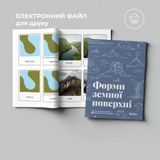
If this approach resonates with you, our new workbook will take this exploration even further.
With it, a child can gradually follow the same path: first see, then compare, then name, and finally generalize the concept.

The workbook includes:
-
real images of land and water forms;
-
matching activities;
-
comparison exercises;
-
three-period lessons, nomenclature and information cards;
-
posters for classroom use;
-
a volcano experiment guide;
-
printable materials for repeated use.

It works beautifully both at home and in a classroom or learning center.
Children can match cards to models, find the same forms in different contexts, create their own forms from sand or clay, build their own “maps,” and invent stories about islands, rivers, and journeys.
These activities combine sensory experience, language development, thinking, and imagination.
.jpg)