Author: Alina Khoma
CEO of bavka, Montessori educator
When you have several children sharing one room, it may feel almost impossible to organize a “Montessori-inspired” space. The youngest reaches for everything that belongs to the older siblings, while the older ones constantly worry about their “treasures.”
We received very real and relatable questions from Natalia Ilkiv — a Montessori-aligned mother and author of a blog about respectful, unconditional parenting. These are questions many families with two or more children ask.

So we explored them through three lenses:
-
The Environment
-
Materials
-
Grace & Courtesy (rules for interaction)
1. How can we set up a space for the youngest child while staying true to Montessori principles and minimalism?
Minimalism is not about having “few things.” It is about clarity of choice for the child.
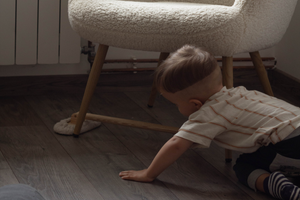
Children under three go through a sensitive period for order.
A simple, predictable environment helps them feel safe, grounded and confident.
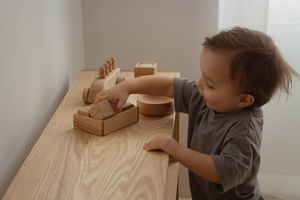
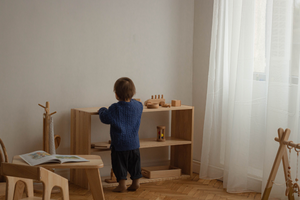
A small “child’s corner” in a shared room is enough.
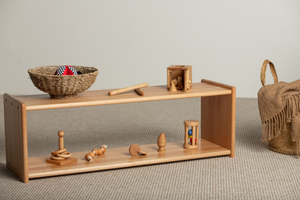
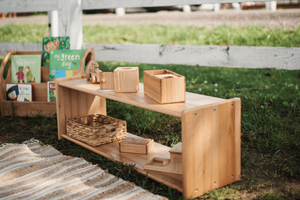
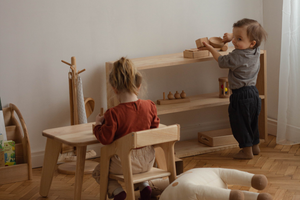
It can be a low shelf or part of a bookcase with materials placed at the child’s eye level, so they can access everything independently.
The 3–5 materials rule applies only to the youngest child’s shelf, not the entire home.
Families with children of different ages naturally have more materials — and that is completely normal.
Older children’s shelves can contain more items and more variety. Their materials may stay in the same room — just out of the toddler’s reach. There is no need to hide them away or “wait for a better time.”
.jpg)
How to organize the shared space so everyone feels comfortable:
-
Lower shelves — for the toddler (large, simple, safe materials)
-
Middle shelves — for children who are already walking
-
Upper shelves — for older children or sets with small, complex pieces
-
A table or work rug for the older child — a space where the toddler cannot reach
-
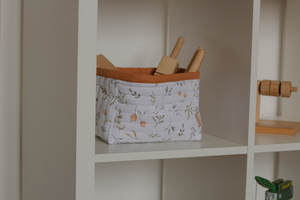
Containers with latches or lids — accessible only to the older child

The youngest child needs a clear, limited set of visible choices. They work with what they see — not with what is “somewhere in the house.”
At the same time, older children can have building sets, figurines, complex board games, craft supplies, LEGO, books, instruments — all of it can stay in the room, simply above the toddler’s reach.
When older siblings want to play near the toddler, they choose materials safe for everyone: large blocks, animal figurines, cars, simple sorters, role-play sets (kitchen, doctor, shop).
More complex toys stay on higher shelves.
So the “3–5 materials rule” does not limit the older child — it protects the youngest from overstimulation and helps them develop in a calm, structured environment.
.jpg)
Rotation
Most parents imagine “rotation” as clearing the shelf and replacing everything at once.
This is easy when you have one child — but not when there are several children, each with their own pace and interests.
A simultaneous rotation for all children often creates chaos.
A better option is a staggered rotation:
-
Toddler shelf: 1–2 items every 1–2 weeks
-
Older child: every 3–4 weeks or when interest fades
-
Shared zone: minimal changes (new books, seasonal item)
The toddler sets the rhythm. They are the most sensitive to overwhelm and the least able to orient themselves independently.
When the toddler’s shelf is in order, the whole room feels calmer.
Older children naturally show when their materials are ready to be rotated — they stop choosing them, use them “mechanically,” or show a new interest (animals, building, art, etc.).
Rotation in a multi-age home is a subtle adjustment, not a full makeover.

2. When all children are little and stay close together, the youngest ends up accessing all the older kids’ toys. Can this be controlled at all?
In a family with several young children, perfect control is neither realistic nor necessary.
What works is a realistic environment, not constant supervision.
Vertical organization is your best friend.
The toddler simply cannot reach high shelves — this becomes your natural “control mechanism”:
-
lower shelves — for everyone
-
middle — for children who walk
-
upper shelves — for older kids or materials with small parts
This is not about “forbidding” but about removing the trigger from the toddler’s reach.

An older child’s table
A dedicated table (child table, part of the kitchen table, a windowsill, a higher shelf) becomes the zone for materials the toddler cannot access.
What’s on the table = not for the toddler.
What’s on the lower shelves = for everyone.

Containers
Transparent latching boxes allow older children to keep their special materials accessible only to them while avoiding conflict.

So is it possible to control access?
Yes — when we control the environment, not the children.
When the space “communicates” what is available to whom, when there is less clutter, and rotation is thoughtful — the pressure on parents decreases, and children naturally play together without conflict.
3. How to organize a shared living space (living room or kitchen-living room) where the family spends most of the day?
This is often the hardest part of the home — because everyone lives here.
The goal is not to create a “perfect play corner,” but to design a space that works for everyone without turning the living room into a storage room.
A shared space should function as a “yes space” — where everything is safe and appropriate for the youngest child.
Again, one shelf works well:
-
lower shelves — for the youngest
-
upper — for the older children
Containers help keep things organized.
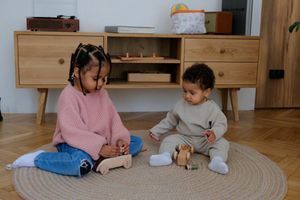
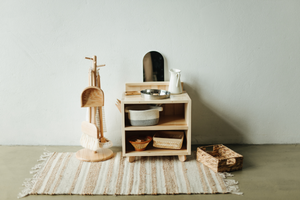
A shared rug helps define a clear play boundary so toys don’t “travel” around the room. This simple rule makes cleanup easier and prevents overwhelm.

Materials suitable for a shared zone:
-
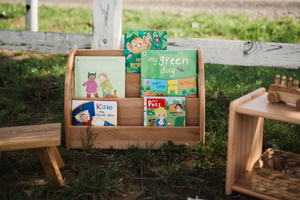
a basket with 5–7 books
-
animal figurines
-
a simple building set
-
practical life tools (broom, mop, cloths)
-
a ball
-
a doll
-
toddler-safe art materials
Interaction rule:
“What’s on this shelf is for everyone. What’s on your table/in your box is yours.”
This eliminates many conflicts with one sentence.

4. A child loves tiny things — figurines, stones, cards, “treasures.” How can we prevent chaos without dismissing their passion?
Between ages ~2.5–6, children naturally enter a phase of collecting small items.
It helps them explore the world, categorize, express identity, and feel in control.
But with a toddler around, these items pose both safety and emotional challenges.
A personal treasure box helps enormously.
Just one — fully owned by the child. They decide what goes inside and in what quantity.
This builds a sense of ownership and reduces sibling conflict.

Another option is material-based sorting:
-
one box for figurines
-
one for cards
-
one for stones
The container naturally limits the amount: when it’s full, the child chooses what stays and what goes.
5. How to keep the youngest safe if the older kids have small parts (LEGO, miniatures)?
The most effective rule:
Older children need a “high zone.”
A small table, windowsill, or part of the kitchen table.
When the older child knows, “If I want to play with small pieces, I go here,”— tension disappears.
The toddler simply can’t reach.

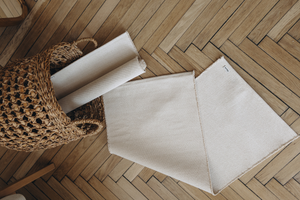
Montessori classrooms use a powerful tool — the work rug.
What’s on the rug is “in use” and considered off-limits.
This shifts the rule from “don’t touch your sister’s toy” to “this material is on the rug right now.”
Space sets the boundary instead of parent-imposed conflict.
.jpg)
Offer the toddler meaningful alternatives mirroring the older child’s activity:
-
Duplo instead of small LEGO
-
larger figurines
-
big blocks instead of tiny pieces
Role of the adult:
Not control — but language modeling.
For the older child:
“You can say: ‘I’m playing with this now. You may use it when I’m done.’”
For the toddler:
“This is not for you yet. Here is something you can use.”
This gradually builds a culture of respecting each other’s work.

An example of space organization using the TROFAST, which can provide partially open storage for a younger child and closed storage for older children.

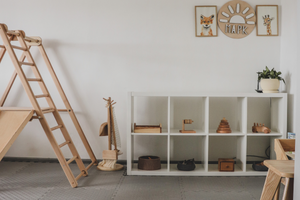
An example of space organization using the KALLAX system, which can provide partially open storage for a younger child and closed storage for older children.
We hope this article inspires you to see your home through your children’s eyes — and let the environment do part of the work for you.
Montessori helps us create conditions where each child can grow at their own pace while feeling respected and safe.
If you enjoy topics like gentle parenting, multi-age family dynamics, and conscious, peaceful daily life, we invite you to explore Natalia’s pages.
There you’ll find warm, honest, practical insights that can accompany you on your parenting journey.
Follow the links to connect with her work and stay inspired.
Cultivating Montessori-friendly Spaces with Multiple Age Children
Montessori Mixed Age Groups: in school & with siblings at home
Look Inside our Multi-Age Playroom Toy Rotation for Three Young Kids