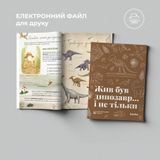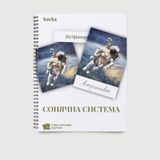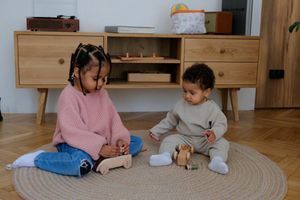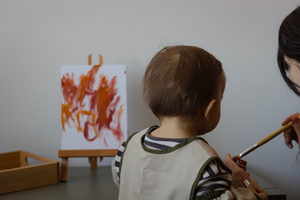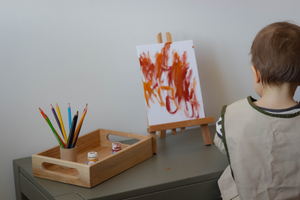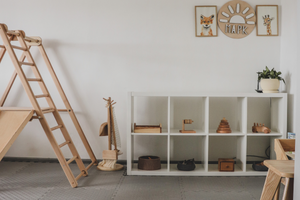
If you don’t know where to start — this is one of the most engaging ways to set up the space. Hang a picture (or even a few) at your child’s eye level. When it’s placed where your child can easily see and reach it, you encourage curiosity and questions, and you gently inspire them to create their own art. Nothing overly bright, distracting, or confusing. Simple and beautiful.
⠀

Why?
In a Montessori environment, wall art is not just decoration — it becomes a developmental material:
-
It supports language development. A picture gives you a natural reason to talk. Children often have questions about what they see, and those questions invite real dialogue.
-
It trains focus and attention. Your child will practice looking closely, noticing details, and imagining their own stories. This often leads to making something of their own — and that concentration is also a great exercise for the brain.
-
It nurtures aesthetic sense. Through images, children refine their taste and learn to recognize beauty. They become interested in culture and the events or themes shown in the artwork.

What to choose?
In children’s spaces, the most attractive images are usually natural objects and real-life scenes. A key Montessori principle is to immerse the child in reality-based images. But most importantly, the images should inspire, uplift, and genuinely captivate. Their purpose is to show children the possibilities of the world — and encourage them to explore the planet: its land, sky, and oceans.
Choose realistic images of children, people, animals, plants, natural phenomena, and everyday life scenes — anything your child can meet in real life.
From the first months, black-and-white patterns work well. They help the baby practice focusing their gaze. After about 2.5–3 months, replace them with a large, bright image of a real object on a white background.

How?
-
Find your child’s eye level by standing your child in front of the wall.
⠀ -
Pick the right spot. Sit in the room, look around, and think about where the image will be seen best. Often pictures are hung opposite the child’s bed or above it, in the play area, or anywhere your child spends the most time. You can also choose places that may seem unusual — like the bathroom, kitchen, or the hallway where your child gets dressed.
⠀ -
Choose the image. You can buy a print, find one online (for example, in a carousel подборки/добірки), cut it from a book, or use a photo. It can be an artist’s work or something handmade — even a simple herbarium you create yourself.
⠀ -
Involve your child. Hang the picture together.
⠀ -
Let the images “grow” as your child grows. Rotate pictures as your child’s interests change — or when you notice they no longer pay attention. For some families, changing images twice a year is enough; for others, monthly works better.

Where?
Place pictures at your child’s eye level in the places where your child spends the most time:
-
in the kitchen, above the child’s small table or eating area;
-
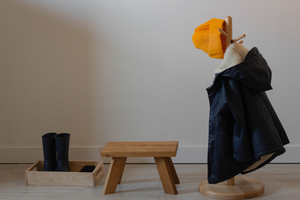
in the hallway, where the child gets dressed;
-
in the bathroom;
-
above the bed;
-
near the play area.
Pictures and images should be rotated. When you notice your child has lost interest, you can replace them with something new. As a child grows, their experience expands — and the developmental materials around them should change too. Images need to progress in meaning and storyline in order to keep their developmental value.
You can rotate images by season or holidays, introducing culture and traditions and enriching vocabulary along the way.
You can find artwork on stock-photo websites and print it, purchase prints from artists, draw something yourself, or create your own pieces. Here is a short list of artists whose works can be printed for a child’s room.
Well-known international artists:
Morgan Weistling

Donald Zolan

Arthur John Elsley

Well-known Ukrainian artists:
Kostiantyn Trutovskyi

Mykola Pymonenko

Ivan Marchuk

Tetyana Yablonska

Arkhip Kuindzhi

Kyriak Kostandi

Serhii Vasylkivskyi

Yosyp Bokshai

Which artist’s work would you hang in your child’s room? Share in the comments!