Author: Alina Khoma
CEO of bavka, Montessori educator
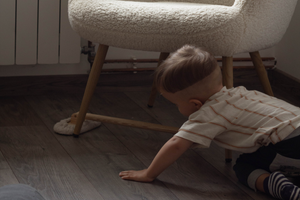
When we imagine traditional learning, a classic school desk usually comes to mind. However, Maria Montessori once made a revolutionary observation: “What the schools need is more liberty, not such a contraption as a desk.” She noticed that sitting at heavy, stationary desks restricts a child's natural need for movement and hinders their development.
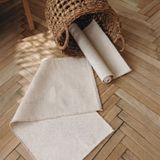
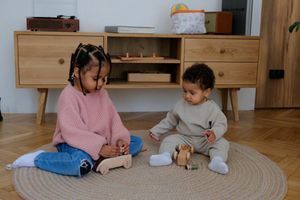
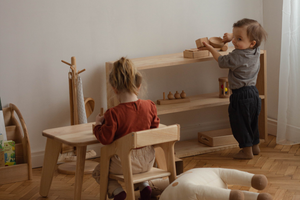
It is natural and comfortable for a child to work on the floor—there is more space for large projects, laying out cards, or building towers. But to prevent the work from turning into chaos and the materials from getting lost, Dr. Montessori came up with a simple yet ingenious tool: the Montessori work rug.
.jpg)
How Was the Idea of the Work Rug Born?
Maria Montessori sought to give children freedom of movement, but she understood that complete freedom without limits could lead to disorder. She did not want educational materials to lie chaotically right on the floor, where they could be accidentally stepped on. Thus, small, solid-colored fabric rugs appeared in Montessori classrooms.
For a child, this element became something much greater than just a piece of cloth. Unrolling the rug turned into a special ritual. When a toddler rolls out the rug, it symbolizes the start of an exciting activity. And when they roll it back up and return it to its place, the activity is officially completed. This simple cycle helps the child internally organize their actions, calm down, and tune into deep concentration.
.jpg)
What Is the Superpower of the Small Rug?
At first glance, it is just a textile floor element, but for a child's development, it fulfills several fundamental tasks:
-
Clear visual boundaries. The rug creates a child's personal workspace. Other children in the classroom (or siblings at home) see this boundary and learn to respect someone else's work—they walk around the rug and know they cannot take things from it without permission.
-
Protection from distractions. When all materials are gathered in one defined space, it is easier for the child's mind to focus. The little one does not scatter their attention on everything happening around them.
-
Preparation for reading and writing. When arranging objects on the rug, children subconsciously do it the same way we read: from left to right and top to bottom. This lays an excellent foundation for future learning and school readiness.
-
Development of motor skills and coordination. The process itself—taking the rug, carrying it, carefully unrolling it with both hands, and then rolling it back up evenly—is a wonderful exercise for motor coordination and strengthening hand muscles.
Step-by-step presentation algorithm (unrolling)
- Preparation: Walk together with the child to the storage area. Slowly take the rug vertically with both hands, pressing it against your body, and carry it to the chosen spot on the floor.
- Body Position: Kneel down next to the child. Place the roll horizontally in front of you so that the loose edge of the fabric faces you.
- Unrolling: Place the fingertips of both hands on the roll. With slow, synchronous movements, push the roll forward, allowing it to unroll under the guidance of your hands.
- Smoothing: Once the rug is completely unrolled, glide your palms from the center to the edges, showing how to make the surface flat and even.
- Rolling up (reverse process): Kneel down at one of the short edges of the rug. Fold the edge with both hands and slowly roll it away from you, making sure the sides remain perfectly aligned.
.jpg)
Can a Regular Blanket or Towel Be Used Instead of a Special Rug?
It is possible at the initial stage. The main thing is that the fabric should be solid-colored (without bright patterns that distract attention from the material itself) and thick enough so that the corners do not curl during the child's movements. Professional classroom rugs hold their shape and are designed to be easily rolled up by the child independently.
Practical step for today: Try to dedicate a separate, small, solid-colored rug for your child's activities. Show them slowly how to unroll it with both hands: “This is where we lay out the puzzle. While it is on the rug, this is your space. When you are finished, we will roll up the rug and put it back on the shelf.” Observe how your child's attitude toward their materials changes.
.jpg)
Creating a Harmonious Montessori Environment at Home and in the Classroom
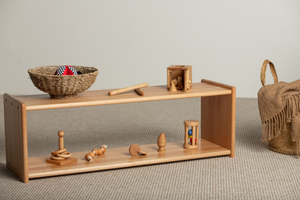
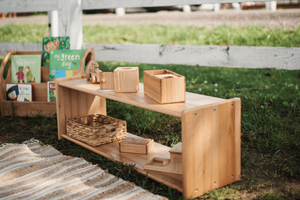
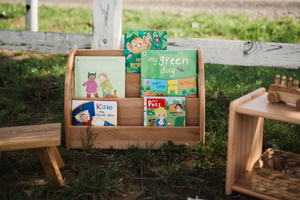
For a child to easily maintain order, everything around them must be adapted to their height and strength. That is why, when creating a space, it is important to take care of aesthetic and convenient storage.
We at bavka know how crucial it is to combine the philosophy of the method with the practicality of real life. Specially for cozy home spaces and professional classrooms, we have created our new product—an aesthetic, natural Montessori work rug that is perfect for children's hands, does not distract with extra patterns, and rolls up easily.
.jpg)
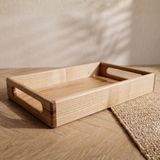
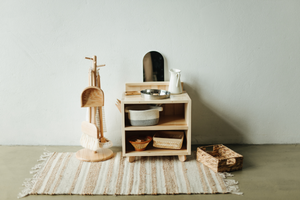
To solve the problem of chaos in the storage area, we custom-make exclusive wooden Montessori rug stands. Such a stand helps keep all work mats vertical, organized, and within the direct reach of children in the classroom. This adds genuine coziness to the space and motivates independent activities.
.jpg)
If you want to try this approach in your family or update the equipment in your group, you can buy a Montessori work rug along with a stand, creating a space where respect for the child's work and a peaceful atmosphere prevail.
.jpg)
Alina Khoma
Montessori educator and founder of the bavka brand