Author: Alina Khoma
CEO of bavka, Montessori educator
How to Read to a Baby
When the first wordless book appears in your home, it often brings confusion. The book seems right, beautiful, recommended — yet it is unclear how exactly to read it. It may feel as though reading cannot happen without text. In early childhood, however, reading looks very different.
For a baby, reading is not primarily a story with a beginning and an ending. It is a shared experience — contact, connection, and the presence of an adult. When you read to your child for the first time, they read your voice, your gaze, your movements, and the repetition. This is how the very first experience of language and attention is formed — simply and naturally.
Starting with the Cover
It is worth starting with the cover. By not skipping it, you already demonstrate a different attitude toward the book. Do not rush to turn the pages. Show your child the image, name it, and return to it again. For a young child, the cover is the strongest visual stimulus.
If a book is constantly in sight but no longer вызывает a response, this does not mean the child does not like reading. More often, it is a signal that this particular book no longer matches the child’s current developmental stage and needs to be replaced. This is where book rotation becomes especially helpful.
The Role of Repetition
Reading with babies is impossible without repetition. Repeating the same word, gesture, or intonation is one of the most effective ways to support learning at this stage. Through repetition, the brain begins to recognize and connect sound with image. At some point, the child may respond with a look, a sound, or a movement — and this can already be considered participation in reading.
Repetition in Practice
Using this book as an example, let’s look at how to read with a baby.
Show your child the baby on the cover. Say:
“This is a baby. A baby. Where is the baby? Here is the baby.”
Use repetition and change your intonation. Point to the eyes, moving your finger as if a fly is flying over the object and landing on it. Name the eye. Invite the child to point to the eye with their finger.
You can add simple actions:
“Let’s tickle the baby’s leg,” imitating the movement and making a playful tickling sound.
If the book contains many repeated images, point to each one and say: “baby, baby, baby.” On the next pages, pause and stretch out the first syllable of the word — the child may try to complete it.
Each emotion can be named and imitated. This becomes an engaging and playful interaction that invites the child to participate. You might use simple phrases such as:
“The baby is laughing,” “the baby is crying,” “the baby is thinking.”
Simple Actions
You can pretend to smell a diaper in the picture and say:
“Eww, what a smell.”
Use your own natural words and intonation. Add gestures — covering your nose, waving your hand away. Show your feelings through facial expressions.
Reading can also be accompanied by gentle touch:
“Let’s stroke the baby’s hand,”
“Now the leg,”
“Let’s stroke the hair.”
Avoid Constant “What Is This?”
Parents often make the mistake of repeatedly asking a child about things they do not yet know. Pointing to every image and constantly asking “What is this?” creates tension and turns reading into an interrogation.
A much better alternative is simple commentary and guidance.
For example, if you see a cup in the book, you might say:
“Look, a cup. Let’s have a drink,” accompanied by a sipping sound.
If you see a spoon, imitate the motion of bringing it to the mouth.
If you see a drum, do not ask what it is — show how to tap it right on the page.
Gestures and Sounds
On pages with food, show actions using gestures and add sounds. You can imitate breaking a piece of bread, lifting a spoon to the mouth, biting an apple, sipping soup, or smelling food. The brighter and more expressive these sounds and movements are, the more engaging the reading experience becomes for the child.
Choosing Books
The choice of books also plays an important role. For first reading experiences, it is worth being cautious with sound- and light-based entertainment books. They quickly capture attention but leave little space for live interaction with an adult. In such books, attention shifts from language and connection to buttons, sounds, and effects. The child interacts not with the book as a source of meaning, but with an object of stimulation.
This does not mean such books are forbidden, but they rarely support the development of a love for reading. It is generally better when most early books are sturdy board books.
Books with realistic images, simple scenes, and clear objects offer far more opportunities for conversation, observation, and shared attention. When an adult points to an object, names it, and repeats the word with different intonation, the child is not being tested — they are receiving a language model.
The Adult’s Voice
The adult’s voice plays a crucial role in this process. Intonation, pauses, tone, and rhythm create an emotional context. A baby may not yet understand the meaning of words, but they accurately perceive mood. This is why the same book can calm or excite a child — depending on how it is read.
Interactive Books and Boundaries
A book for a baby is not limited to visual perception alone; it comes alive through movement. We show simple actions with gestures, imitate smelling, eating, touching, and sounds. Books with flaps or simple interactive elements can work well as an encouragement tool, as long as the adult remains the guide in the process. Opening a flap becomes part of reading rather than the goal itself.
It is important for the child to gradually understand that a book is not a toy, but a space for shared, meaningful time, calm exploration, and receiving new information — even when elements of play are present.
A Place for Reading
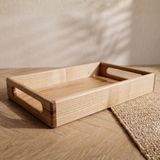
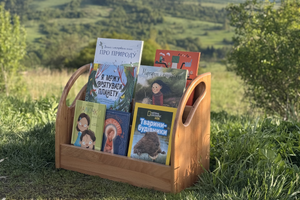
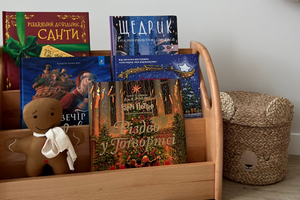
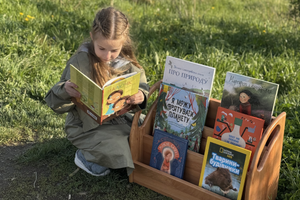
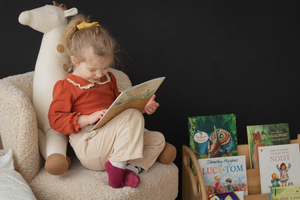
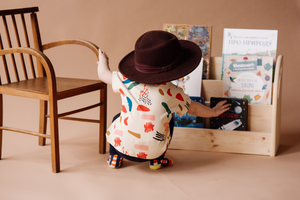
An organized reading area is essential for fostering a child’s love for books. Order in this space helps the adult notice which book no longer sparks interest and replace it in time — not because the child cannot physically reach it among others, but because they see it every day and no longer respond to it.
It is important to ensure that books are accessible to the child, so reading does not have unnecessary barriers.
Moving Toward Text
Over time, reading naturally changes. As a child’s vocabulary grows, the number of images on a page can decrease, and text can appear gradually. The transition to books with text should not be abrupt. At first, these are simple phrases, minimal details, and more visual “space” on the page. A child who has experienced calm, live, unhurried reading will accept such books more easily and sustain attention for longer.
In Conclusion
Reading in early childhood does not have an academic goal and should not be preparation for school. Think of it as a way to be together — to listen, observe, notice details, invent your own meanings, and talk about what matters. Even a few minutes a day create a sense of closeness and safety. From this experience, interest in books and in what books contain gradually grows.
Read also: