Why I Recommend Preschool Prep a Year Early — While Believing It Won't Truly Prepare Children for School
Sounds like a paradox? Only at first glance. I genuinely believe prep courses are worthwhile. They offer a valuable experience: getting accustomed to the lesson format, learning to work in a group, and interacting with other adults. Yet all too often, we confuse "academic drilling" with genuine readiness.
Recently, I completed a 6-hour training webinar, "School Readiness," led by Viktoriia Vyunnyk — PhD in Education specializing in Early Childhood Education, head of the "Super Sad" training center, founder of the Kyiv-based space of happy children Graroom, author of developmental workbooks, and mother of four sons who seamlessly blends professional expertise with everyday parenting.
.jpg)
This webinar served as a powerful catalyst that brought complete clarity to my thoughts as both a mother of a schoolchild and someone deeply immersed in creating developmental environments for children. True readiness isn’t built at a school desk, and an instructor on a prep course isn't a magician who can pull off a miracle in two months. If you look at the New Ukrainian School (NUS) standards, you’ll see that what’s expected of a first-grader isn’t calligraphy, but brain maturity.
What should parents really pay attention to?
What skills does a child actually need?
School readiness is a comprehensive system spanning physiological, psychological, and intellectual maturity. Here are the core developmental markers that show a child is ready for the start:
1. Self-regulation and executive control. This is the biggest challenge for children today. A child is ready if they can respond to the word "stop," follow an instruction all the way through, switch smoothly from one activity to another, and avoid giving up at the first sign of failure or fatigue
2. Cognitive flexibility and logic. School requires deep understanding, not rote memorization. The child should:
-
Grasp cause-and-effect relationships (e.g., complete the thought: "The bus didn’t arrive on time, so we...").
-
Classify objects and identify the "odd one out."
-
Understand logico-grammatical constructs (e.g., answer: "A plane is faster than a car. Which is slower?").
3. Communication skills (Soft Skills for NUS). Modern learning is built on collaboration. A child needs to be able to work in pairs and small groups, articulate their perspective, solve problems collaboratively (a win-win approach), feel confident presenting their ideas, and realistically evaluate their own work.
.jpg)
4. Speech quality and general knowledge. This is about far more than just sounding out words by syllables. Speech quality starts with a rich vocabulary, understanding words and their nuances, and the ability to describe an object — which forms the foundation for formulating thoughtful questions and coherent sentences later on. It is essential to cultivate phonemic awareness: hearing non-verbal and speech sounds, distinguishing them, identifying a sound’s position within a word, and naming words that begin with a specific sound. Pay close attention to grammatical accuracy (avoiding agrammatisms like mismatched genders or cases) and clear articulation. Moreover, children should be oriented in the world around them: distinguishing wild animals from domestic ones and knowing their young, recognizing types of transportation, vegetables, fruits, and professions.
.jpg)
How to Foster This at Home (and why it is the parents' domain)
These competencies cannot simply be "drilled" into a child’s head during a couple of hours a week at a development center. They are cultivated at home, in the rhythm of daily life.
-
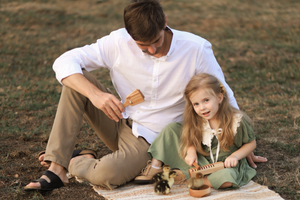
Involve them in everyday household routines and caring for their space. Self-organization doesn’t start with neatly arranging pens in a pencil case; it begins with the ability to take care of oneself at home. Looking after personal belongings, tidying up regularly, and preparing meals together are among the best workouts for the developing brain. When a child helps in the kitchen (such as washing vegetables or kneading dough), sorts laundry, or tidies their desk, they learn to sequence actions, sustain attention, finish what they start, and see the outcome of their effort. Meaningful involvement in household routines builds responsibility that translates naturally into school life — from packing a schoolbag to completing homework independently.
-
Play rule-based games. To train the brain's inhibitory control and focus, play games with a "stop" cue (Red Light, Green Light or Statues), games requiring sequential planning (Robot, where the child directs your steps), and task-switching games (Wind, Rain, Sun).
-
Engage in rich, nuanced conversations. Discuss what you see around you, compare objects, look for antonyms, and discover the world through natural curiosity.
.jpg)
Major Parenting Mistakes in School Preparation
With the best intentions, we often inadvertently discourage a child from wanting to learn long before the first school bell rings. Here is what should strictly be avoided:
-
Focusing exclusively on academic knowledge. Teaching a child to count is easier than teaching them how to process losing a game gracefully or ask for help when stuck. Yet it is the absence of social-emotional skills that turns first grade into ongoing stress.
-
Language of intimidation (taboo phrases). Never turn school preparation into a threat. Phrases like "They won't accept you into school if you...", "Other kids will laugh at you," or "Only silly children say that" must be strictly off-limits. They generate nothing but anxiety and self-doubt.
-
Overparenting (helicopter parenting). "You're doing it wrong! Let me just do it for you!" — when you pack their things, control every stroke of their pencil, and deny them the right to make mistakes, you rob them of the chance to learn how to learn.
.jpg)
To sum up: courses taken a year before school help build an understanding that learning is engaging, and they introduce children to routines, following structured instructions, and working with books and notebooks — everything needed to transition into the new role of a student. But the true foundation of readiness — independence, resilience, critical thinking, and faith in one’s own abilities — is built by us, the parents. Day by day, simply by living life together.
.jpg)