In parenting, it’s easy to get lost in a sea of conflicting advice. Some say, “Just wait until they turn three; they’ll start talking on their own,” while others raise alarms with daunting terminology from the very first months. At bavka, we believe that a parent's best anchor is clarity, peace of mind, and evidence-based knowledge.
A child's speech is not merely the ability to pronounce sounds—it is the tip of a vast "developmental iceberg" built from the earliest days of life through movement, sensory experiences, and meaningful interactions with loved ones.
To understand how the foundation of speech is truly built, we spoke with Anastasiia Ostrovska—a special education specialist, speech therapist, deaf educator, and founder of the Center for Hearing and Speech Correction in Uzhhorod.

— Anastasiia, welcome! Could you tell us a bit about your background and the core mission behind your work with children and parents?
— Hello! My name is Anastasiia Ostrovska. I am a special education specialist, speech therapist, deaf educator, and I am currently completing my master’s degree in psychology. For over 20 years, I have worked with children who have complex developmental challenges, including hearing, speech, communication, and neurodevelopmental disorders. I am the founder of the Center for Hearing and Speech Correction in Uzhhorod, where my team and I provide comprehensive interventions for children with special educational needs (SEN).
The most vital message I’ve tried to share with parents over the years is that visiting a speech therapist—much like seeing a pediatrician—shouldn't happen only when a problem arises, but as part of regular age-appropriate "check-ups." After all, development requires just as much care and attention as physical health, especially during early childhood and the preschool years.
— Why are early consultation and regular check-ups so crucial? Why shouldn't parents wait until the arbitrary age of 3 or 5?
— Speech and overall developmental issues don’t happen overnight. They build up gradually, and a specialist can spot early signs long before parents notice them. That’s precisely why early intervention is so critical.
Timely diagnosis and correction allow us to build proper communication mechanisms effectively and avoid secondary challenges in learning and social adaptation. Speech, after all, is merely a tool for communication. Our ultimate goal is meaningful interaction with people and the world, giving the child the ability to express themselves, be heard, and live a happy, fulfilling life.

— You mentioned that speech is just one part of a larger process. What foundation needs to be in place before a child utters their first words?
— Speech doesn't emerge out of nowhere. It relies on essential prerequisites—a foundation of skills and processes we call pre-linguistic communication.
Before a child can say their first words, let alone string them into phrases and sentences, they need to possess:
-
Sustained eye contact
-
A pointing gesture
-
Joint attention
-
Imitation skills
-
The ability to hear and understand spoken language
-
The ability to follow simple instructions
-
Meaningful feedback and responsiveness
-
An initiative to communicate and play together
We pay close attention to how a child gets our attention, responds to speech, and communicates their intentions and needs through eye contact, gestures, and behavior. We place special emphasis on play, as play is a child’s primary activity and the main vehicle through which they learn. How and with whom a child plays, the selection of toys, the organization of their space, and the balance between free play and structured learning—it is truly an art form.
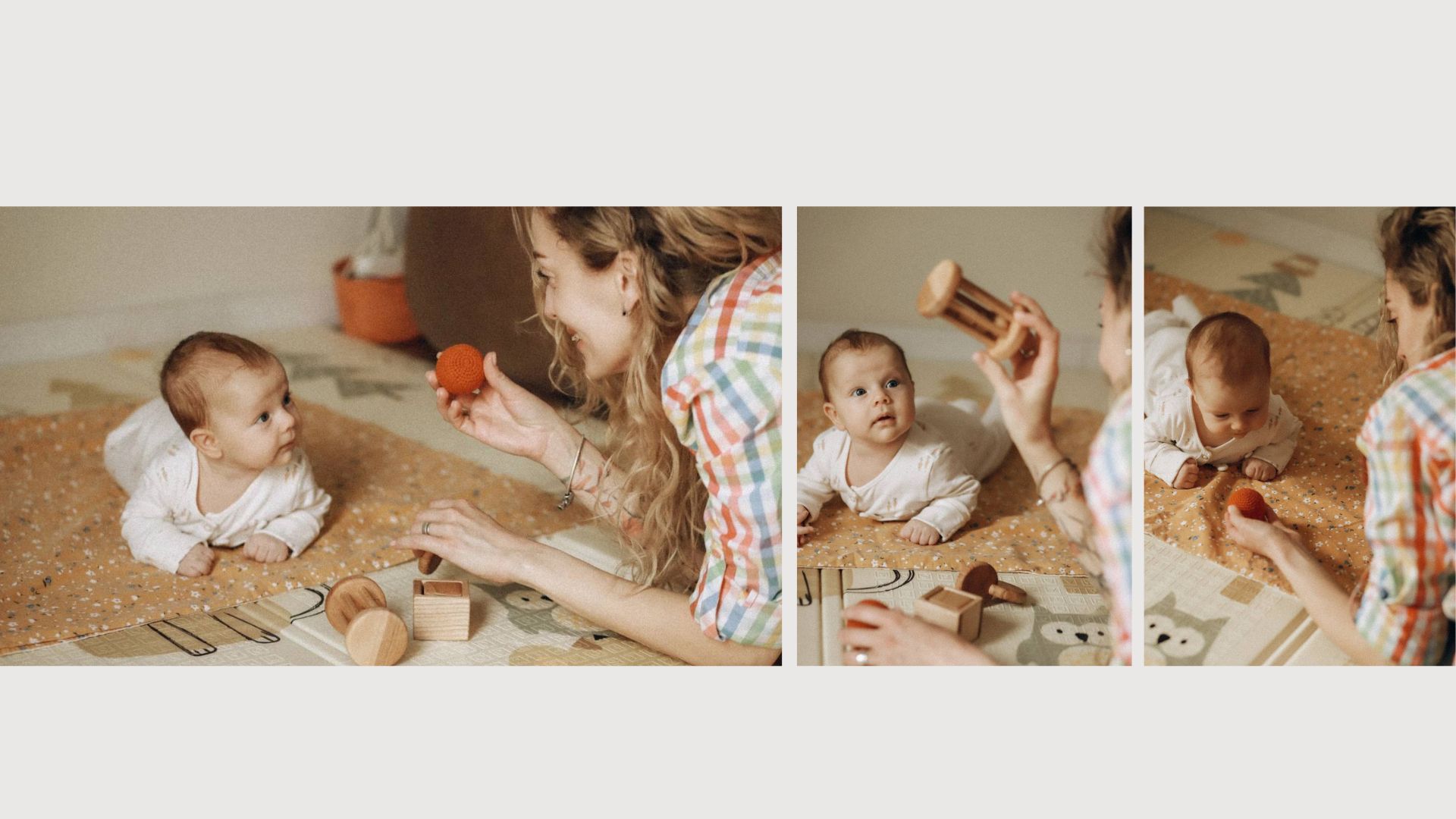
— That resonates so deeply! In the Montessori approach, we often say, "The hand is the instrument of the mind." Maria Montessori emphasized that speech, thought, and movement develop as an interconnected unit. When a child explores objects with their hands, maintains eye contact, moves objects, or mimics adult actions, they are actively building neural pathways that later "unlock" active speech. What developmental markers can parents look out for starting from the first months of life?
— All the markers I mentioned can be evaluated from a very early age. Mutual responsiveness is our primary focus from the very first days of a child's life:
-
At 2–4 months: We evaluate responses to sounds and voices, the ability to establish and hold eye contact, and overall emotional responsiveness when addressed.
-
As they grow: We monitor cooing and babbling, language comprehension, pointing, following instructions, and imitation.
-
Over time: We observe whether first words, phrases, and sentences emerge on schedule, whether the child’s vocabulary is adequate for their age, and if articulation, grammar, speech breathing, and prosodic features (rhythm and intonation) are developing properly.
— So, a modern speech therapist looks at a child's development far beyond simply teaching them how to pronounce specific sounds?
— Exactly! Speech therapy isn't just about sounds. It’s about holistic development:
-
Speech, hearing, and communication
-
Play, reading, and writing readiness
-
Voice and breath control
-
Bite alignment and tongue posture
-
Switching focus, bodily awareness, and much more
Our strength lies in an integrated approach to early identification and correction. Unfortunately, working with a 5-year-old rarely yields the same rapid, effortless results as working with a 2-year-old. The developmental path of a child who starts speaking at 1.5 years old versus one who starts at 4.5 is vastly different. Delayed speech onset frequently leads to cognitive delays and learning difficulties later on.
— What advice would you give to parents who are feeling hesitant or anxious about their child’s development?
— My sincere advice to parents is: don’t wait for problems to become more obvious, and don’t listen to anyone who dismisses your concerns (because, in the end, the responsibility falls on your shoulders). Seek professional advice as soon as something starts to worry you.
It is far easier to consult a specialist, double-check, and—if needed—receive timely help with maximum results, than to navigate a much harder, longer road down the line.
If you have doubts about any of the following, that alone is reason enough to book a consultation:
-
Interaction and engagement
-
Responses to voices
-
Speech comprehension
-
Following instructions
-
Gesture development (including pointing, nodding "yes," and shaking "no")
-
Imitation skills and play behavior
— What can parents expect during a speech therapy check-up?
— A "speech check-up," similar to a routine medical exam, provides clarity on:
-
Overall developmental level
-
Pre-linguistic communication skills
-
Speech quality, auditory function, and phonemic awareness
-
Communication, play, and learning behaviors
-
Cognitive processes (memory, attention, thinking, imagination)
-
Sound articulation and the structure of the speech apparatus
-
Pre-literacy skills (for older children)
If necessary, a check-up helps guide parents toward additional evaluations or specialized therapies. Some children need a speech therapist, others a deaf educator, a psychologist, or a behavioral therapist—while some benefit from a multidisciplinary team. A consultation provides a clear roadmap.
— Lately, we’ve seen you highlight musical games and rhythm in your work. Tell us about your new handbook for home activities.
— Yes! Today, speech activation is one of the most frequent reasons parents seek out a speech therapist. Very often, speech delays stem directly from underdeveloped pre-linguistic communication.
My colleague—speech-language pathologist and neuropsychologist Daryna Meshkova—and I see daily how much parents need clear, step-by-step guidance for practicing at home.
So, we combined our experience to create a practical guide filled with musical games titled "Guli-Guli" (Movement. Play. Interaction).
This kit includes:
-
22 original songs and rhythmic nursery rhymes
-
Video demonstrations of the games for easy repetition
-
A downloadable PDF handbook with step-by-step instructions and practical tips
These games help shift a child’s focus from objects to people, teaching them to imitate, feel rhythm, develop auditory perception, master gestures ("yes," "no," pointing), and lay a solid foundation for their first words. It is designed for parents of children aged 1–5, as well as specialists (speech therapists, early childhood educators, psychologists).
— Anastasiia, thank you for such an insightful and warm conversation! What final message would you like to leave with our readers?
— There is no such thing as "excessive anxiety" when it comes to your child's development. Ultimately, their future depends on it.
When is the right time to consult a speech therapist? The answer is simple: "Whenever anything about your child’s development or behavior gives you pause." Every process is interconnected—one building block cannot take shape without another.
So that parents can sleep peacefully at night (instead of endlessly googling) and have the energy during the day to play and connect with their child, specialists like us are here. We help make sense of the journey, offer support, dispel fears, and guide you on what you and your child need most. Reach out—we are always here to help!
— Thank you, Anastasiia! This reconfirms the core principle of the Montessori philosophy: development unfolds naturally when we create the right prepared environment for the child.