November is here, and all the stores are already decorated for the holidays. The atmosphere around us is filled with the anticipation of the upcoming festivities, and children are eagerly waiting for their presents. And this raises the question: who brings all these gifts?
For most of us, this is still a trigger and a painful question. How do we tell our children that Santa doesn't exist, or do we avoid saying it to "not ruin the magic of Christmas"?
And for Ukrainians, there is even more confusion because we’ve finally moved away from the image of Ded Moroz, but who do we replace him with? Santa? But isn’t Santa the one who visits American children on Christmas? And here, on Christmas, it’s customary to receive gifts from Baby Jesus—shouldn’t we receive them at all?
If we understand who St. Nicholas is, what should we do about presents on New Year's Eve? So much confusion… “It would be better as it was before,” many would say. However, I suggest we take a look at this issue today and not complicate things.
.png)
Since I consider myself an expert in raising children using the Montessori method, I want to share how Montessori parents and educators view this issue, and you can make your own conclusions.
Montessori pedagogy is primarily based on forming a real understanding of the world around us. This makes it quite challenging for parents when everything around is filled with fantastic images and characters. The child asks questions that are difficult for us to answer truthfully without further confusing them: which one should they believe, the parents or the advertisements? Even choosing holiday books for children that are based on real plots is a challenging task.
Yes, the image of Santa cannot be avoided during the holidays, but it doesn’t need to be! These are all cultural traditions and customs that it is important for a child to know and understand. However, there is a difference between telling a child the truth and a made-up story! When we say that Santa comes down the chimney on New Year’s Eve and in one night he visits every house on the planet, we are forming a wrong understanding of the real world. On the other hand, when we say that Santa is a symbol of celebration, we are giving the child a real, truthful life experience.
.png)
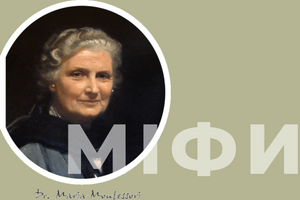
Here is what Maria Montessori herself said about this:
One day, a mother decided to tell her young son that Santa Claus didn’t really exist. When she said this, the boy started laughing and replied, “Oh, Mom! I’ve known for a long time that Santa Claus doesn’t exist!” Surprised, the mother asked, “Why didn’t you tell me?” To which the boy answered, “Because it always made you so happy.”
— Maria Montessori, from The Child in the Family
When I am told that this way we are stealing the holiday from the child, I have one answer: "Don’t be deceptive!" Sooner or later, this great secret will be revealed. In an instant, all the magic will vanish. We might think it’s about “believing in miracles,” but in reality, it’s a great deception. The holiday atmosphere and pleasant warm memories are not given by fictional stories but by spending time together in the family circle, telling interesting stories, the sincerity, and generosity of the holiday, the gifts that are clearly from loving people.
You need to know some facts before making a decision. And if, after all, you decide that Santa will be a part of your family story, that is your conscious and correct choice.
Fact:
From birth to 6 years old, a child is not able to distinguish reality from fiction. Therefore, if you say that reindeer fly, the child believes it wholeheartedly. And when they find out the truth, their whole world may collapse. I still remember the catastrophe of my childhood when my peers revealed the “terrible reality.”
So, the first task is to give children a true, non-fantasy understanding of the world, so that over time they can distinguish it from fiction. This won’t make them less creative or imaginative, as proven by the successes of well-known Montessori school graduates.
.png)
Here are some studies on this issue:
Problems with understanding imaginary creatures:
Children aged 3-5 often confuse fantasy elements with reality, especially when adults actively support these beliefs. For example, children believe in characters like Santa Claus, monsters that take naughty children, etc., and this belief is reinforced by their limited understanding of reality and the influence of cultural customs and adults.
Distinction mechanisms:
As children grow, they gradually begin to understand the difference between reality and fiction. For example, a study by British scientists found that three-year-olds are much more likely to confuse fictional stories with reality than five-year-olds. This development is related to accumulating experience and cognitive skills.
Influencing factors:
Imagination development, prior experiences, and context influence children’s ability to distinguish between the real and the imagined. For example, if a story or character is presented in a playful form, children better understand its fictional nature.
Emotional component:
Some studies suggest that adults may unknowingly support these mistakes through their emotional attachment to children's fantasies (e.g., traditions like Santa Claus), and this can influence children’s perceptions.
You can find more on this topic in works such as Understanding the Fantasy/Reality Distinction by Sharon & Woolley (2004) and Fantasy Understanding in Preschool Children (Martarelli et al., 2015). These sources study how children gradually develop the ability to classify phenomena as real or imaginary.
.png)
How to tell the truth about Santa?
Explain that Santa is a symbol of the holidays:
- "Santa, whom you see in books, movies, and stores, is a person in a costume. People dress up as Santa to remind us…"
- "...about someone who lived a long time ago, St. Nicholas, who secretly gave money to people in need."
- "...to be kind and generous to others in our family or even beyond, especially to those who have less than we do."
How to preserve the magic of the holiday?
Even when we tell children that Santa is a fictional character, we can still play games and preserve holiday traditions that are close to our culture. For example, writing letters, cleaning boots for sweets, or leaving carrots for the reindeer. All these things will bring the magic of the holiday. However, they will be even more meaningful since so much attention and effort go into creating this magic for one another.
In our family, we still keep the secret about the gifts, and this expectation and anticipation preserve the festive interest and create pleasant memories.
.png)
You can also create your own traditions, like we do, when we gather gifts for children who need them before St. Nicholas Day. This way, the child understands that they can also do good for other children and people.
Read with your children about the traditions and customs of other nations. Study different cultures and religions. It will be much easier to explain the differences in holiday celebrations when they have a rich life experience and knowledge about other people. This will help them grow tolerant and respect the opinions and choices of others.
.png)
Do not destroy others' perceptions, it’s their choice, decision, and responsibility.
Some parents worry that their child will tell other kids, “Santa is not real,” and they will have to face the anger of other parents. Explain it to the children this way:
- "Some children and adults may think differently about Santa because they want to play the 'Santa' game. It’s okay when people think differently about things. You can join this game if you want—it’s fun to imagine and pretend. Or you can stay out of it. You don’t have to tell others that 'Santa doesn’t exist,' because sometimes everyone enjoys pretending, just like when you play with your dolls and pretend they are real."
If your child argues with another child about whether Santa is real, say:
- "You think Santa is real, and you think Santa is not real. That’s interesting! Two people believe different things."
.png)
What about St. Nicholas?
Everything related to saints is a personal matter for each family and their religion. A child should know about many religions, how they differ, and what customs different cultures and nations have. This forms their tolerant and empathetic attitude toward all people on the planet.
Our family is Christian. And yes, we honor religious holidays, and we particularly respect St. Nicholas. But we don’t tell our daughter that he put sweets in her boots because it’s not true! We talk about all his good deeds, how he became a saint, and what a great holiday is held in his honor, during which relatives exchange gifts. We enjoy reading books about the history of St. Nicholas, and I am sure this gives her a much richer experience.
Moreover, cleaning boots on this holiday is one of our favorite family traditions. And our daughter is excited about what treats and gifts she will receive this year. So, from experience, I can say that the truth has in no way stolen the magic of the holiday from our child. On the contrary, for our family, it is another wonderful opportunity to create new memories, show care, and give each other the long-awaited gifts. So, both form and content are important, although there seems to be a small difference between saying "St. Nicholas brought me presents" and "I received a gift on St. Nicholas Day."