Author: Alina Khoma
CEO of bavka, Montessori educator
What Does a Child Gain When We Involve Them in Cooking?
-
It ensures the development of valuable Practical Life skills. Cooking helps develop foundational practical life skills that children will carry with them throughout their entire lives.
-
It requires the discipline of following instructions. Following directions is essential for successfully executing any recipe. It also provides excellent opportunities to practice focus and concentration—teaching children to be attentive, careful, and precise in their actions.
-
It helps develop fine motor and sensory skills. Hands-on cooking activities refine fine motor skills as well as hand-eye coordination, concentration, and attention, while beautifully stimulating the child’s sensory receptors.
-
It fosters creativity, independence, and self-confidence. Assisting with food preparation and exploring recipes significantly boosts children's confidence and self-esteem. Just as adults feel a sense of fulfillment from bringing something to life and achieving a goal, children experience the exact same joy. It is incredibly important for them to feel like an active part of the family and make a meaningful contribution. When they prepare something the whole family will enjoy—or even just participate in the process—it gives them a boost of energy, capability, and self-belief that no other activity or fancy toy can replicate.
-
Cognitive and linguistic development. When children independently guide their own actions during cooking, they are prompted to problem-solve and follow sequences to achieve a desired result. Simultaneously, they are introduced to new words and concepts, which naturally expands and enriches their vocabulary.
-
Healthy eating habits. By involving children in the hands-on preparation of meals and snacks, they become much more likely to appreciate nutritious food. Over time, this positive exposure encourages them to make healthier dietary choices as they grow older.
-
Quality time together. Cooking with a child might require more preparation, time, and resources—not to mention the cleanup afterward. Yes, I completely understand that. But doing all of this together allows for truly high-quality bonding. Through this shared process, you are teaching communication, nurturing your connection, and gifting your child vital life experience. You are creating something together.
.png)
What are the benefits for us?
We all want our children to be able to get up in the morning and easily make themselves a simple sandwich by the time they start school. Or prepare a snack after school while we are still at work. We want our children to stay safe in the kitchen and know how to handle household items carefully, even when unsupervised. This doesn't happen by magic just because a child reaches a certain age. It requires intentional, thoughtful preparation during their early years.
.png)
Setting Up and Organizing a Montessori-Style Kitchen
How you organize your kitchen will directly shape both your experience and your child's. A true Montessori kitchen should be, above all, safe, accessible, and child-friendly.
I understand that cooking with a child every single day isn't always feasible. Therefore, to begin with—while your child is still small—treat it as a deeply intentional and beautifully organized learning activity. This way, as your child grows, the process will become natural and seamless, requiring no extra preparation, and they will genuinely want to offer meaningful help.
.png)
First, we need to safely bring the child up to counter height. For this, I highly recommend choosing a comfortable, high-quality learning tower (helper tower). There are also plenty of DIY tutorials on how to build one using step stools. Additionally, consider integrating low children's tables and chairs, step stools, and accessible base cabinets for storage.
Children won't instinctively know where everything is or what it is used for right away. That is why it helps to designate specific zones for food preparation, cooking, and cleanup. This allows the child to develop a clear workflow based on dedicated spaces. Set aside specific drawers or shelves that are fully at their disposal so they can easily access their own working tools.
Read more about how to organize a Montessori kitchen in this post.
.png)
The necessary safety measures will vary depending on your kitchen layout and your child's age. However, it is well worth considering childproof locks on cabinets containing hazardous items, as well as providing child-safe kitchen tools, such as specialized knives and scissors.
It is best to prepare ingredients in a way that matches the capabilities of your child's age group. For instance, for toddlers (18 months to 3 years), you should pre-measure and place all ingredients into separate containers. Their involvement will mainly consist of pouring and stirring. They can also do an excellent job slicing soft fruits and vegetables, peeling a hard-boiled egg, or peeling a banana. On the other hand, preschoolers (3 to 6 years) can take on far more tasks and even prepare their own snacks independently.
.png)
When to Start?
I recommend starting around 18 months, when the child is already walking confidently and coordinating their body and hand movements, but most importantly—when they show a keen interest in this type of activity. How do you spot this interest? Trust me, you won't miss it! Your child will practically demand to see what you are doing, climbing up to "help" in any way they can.
It is vital to involve your child when they genuinely want to participate, rather than forcing it because "it's good for them." We do everything for the joy of it and should truly enjoy the process. Of course, there will be flour on the floor; yes, something might break. These are completely normal parts of the learning journey. Even we adults occasionally break things, despite having fully developed coordination, attention, and a clear understanding of how much that expensive cup cost. So, if a specific item is dear to you, simply swap it out for a different one. That way, if your child accidentally damages something, you won't feel discouraged or resentful of the activity.
What Materials to Use?
Naturally, we worry about safety, and plastic tableware often seems like the easiest solution—but it isn't always the ideal choice. Try to introduce a variety of materials: plastic, silicone, wood, metal, ceramic, and glass.
Even the realization that ceramic and glass are fragile teaches a child gentleness and care. Believe me, no child intentionally wants to damage our things, and breaking something can upset them deeply, too. However, this firsthand experience provides a real understanding of how to handle these objects safely. Metal sounds different, carries a different weight, and feels cold or warm to the touch. Wood offers a distinct sensory experience, lightweight handling, and natural safety. Plastic also has its perks, like vibrant colors. Give your child a rich diversity of sensory experiences!
.png)
What Tools Will You Need?
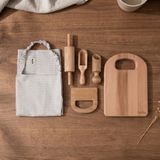
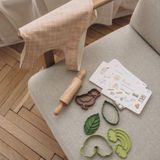
Consider investing in a few kitchen items that will grow with your child and last for a long time. Here are some of my personal favorites:
-
A blunt knife for spreading butter or jam;
-
A child-safe knife for cutting soft vegetables;
-
An apple corer and slicer;
-
A crinkle cutter (wavy blade knife);
-
A small pitcher;
-
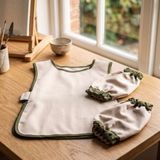
An apron;
-
A child-sized rolling pin;
-
Measuring spoons;
-
A small cutting board;
-
A small whisk;
-
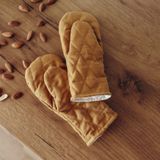
Child-sized oven mitts;
-
A small strainer that the child can easily hold independently.
.png)
You can also purchase a safe, thoughtfully designed set of essential, child-friendly kitchen tools in our shop.
Children are perfectly capable of using many kitchen tools when given proper instruction. The key is giving a presentation (a Montessori "lesson") and emphasizing that these tools are NOT toys and must be used correctly. It is essential to gently explain that certain kitchen tools can be hazardous and require careful handling. If children are properly guided and consistently supervised, they can manage everything beautifully.
This is the only way we can truly protect our children—not by hiding every danger in the world from them, but by explaining how things work and giving them the opportunity to handle them properly under our watchful care.
Food Preparation in the Montessori Environment
In the Practical Life area of a Montessori environment, there are specific activities that allow children to prepare various foods for consumption.
Depending on the children's age, skill level, experience, and interests, you will find a wide variety of prepared food-related tasks in this space. Each activity comes with its own set of materials neatly arranged on a tray. Once chosen, children are expected to complete the cycle of work fully—meaning they clean up all the materials and return the tray to the shelf exactly as they found it.
.png)
Age-Appropriate Food Preparation Ideas (Ages 3 to 6)
-
Squeezing fresh orange juice with a hand juicer;
-
Slicing apples with an apple slicer;
-
Chopping vegetables (carrots, cucumbers, celery) with a wavy cutter;
-
Grating cheese;
-
Making lemonade;
-
Spreading jam or butter onto bread or crackers;
-
Slicing hard-boiled eggs with an egg slicer;
-
Peeling and slicing bananas.
.png)
Once you lay the groundwork and build these foundational skills, your child will be able to help you more frequently and effectively, becoming increasingly confident in their own abilities and potential.
Would you be interested in learning about specific recipes we can cook together with our children?