Author: Alina Khoma
CEO of bavka, Montessori educator
Let’s talk about stickers. When we offer stickers to a child (and this experience can start as early as 10 months), the adult's focus of attention needs to shift drastically. Our interest should lie not in a beautiful final result on the page, but in the child's journey toward it. This is where a crucial stage of developing independence is hidden, one that is very easy to undermine with excessive help or poorly chosen materials.
The good news: the right approach frees up your time instead of taking it away!
1. The main value is in peeling, not in the result
The most important motor and mental work for a toddler is the process of grasping the sticker and peeling it off the backing.
If you peel the sticker yourself and simply hand it to the child, it's wonderful quality time together, but it loses its developmental benefit. Define the goal: we want to teach the child to act independently. In the early stages, an adult can just slightly lift the edge of the sticker to help the baby, but the child must make the rest of the effort themselves.
A moment of healthy laziness: A measured dose of parental laziness in this process is the best stimulant for a child's concentration. When a child tries long and persistently to peel an element on their own, they are training their focus of attention for an extended period.
Important: If the material is poor quality, tears, or won't peel off at all, it is demotivating. The toddler will get frustrated, and pressuring them to "do it all yourself" will only make things worse. Choose high-quality printing.
2. The evolution of stickers: from abstraction to storyline
Don't try to buy a complex activity book right away. Move from simple to complex:
-
Stage 1. Mosaic stickers (abstraction): The first stickers should be regular paper ones depicting abstract or geometric shapes. There is no "right or wrong" rule here. No matter how the child turns a circle or a square, or where they stick it, the task is successfully completed. We are simply mastering the technique.
.jpg)
-
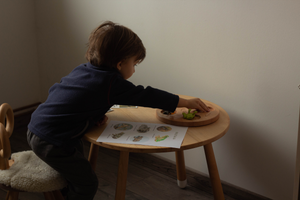
Stage 2. Picture stickers (storyline/contextual): Only after mastering the technique should you move on to object images. This is where logic and context come in: an apple needs to be stuck onto a tree, a bird into the sky, and a kitty onto the grass.
.jpg)
3. Filtering content: age markers and educational workbooks
Parents should critically evaluate what publishers offer:
-
Don't blindly trust age markers: Labels on covers often do not align with a child's actual development. A workbook labeled "2+" might include tasks with a clock and a daily schedule, which is completely irrelevant for a two-year-old. On the other hand, a "3+" workbook might turn out to be perfect for a one-year-old thanks to large and simple elements. Always look at the internal content, not the number on the cover.
.jpg)
-
Educational workbooks are not for independent work: Sticker books on anatomical, medical, or social themes (for example, about viruses or visiting a clinic) are a wonderful therapeutic tool. They help explain complex things about the body or ease anxiety before seeing a doctor, but they must be worked through exclusively together with an adult.
.jpg)
.jpg)
4. What should you avoid? (Montessori taboos)
From the perspective of a child's natural development, certain types of stickers can even be harmful:
-
Motivational stickers and reward stickers: Cards like "Good job!", suns, or stars given for an action are external manipulation and evaluation. They destroy internal motivation. For example, potty training is a natural stage of physical body development. A child should do it because it is natural and comfortable for them, not for the sake of getting another reward sticker. Read more about a child's potty training journey.
.jpg)
-
Unrealistic characters (in the early stages): Monsters, fairies, and fictional creatures offer no developmental value for the youngest children. Children under 6 learn about the world through real-life experiences, and it is difficult for them to separate fiction from reality. Choose images of real animals, everyday objects, and nature.
.jpg)
Checklist: how to safely leave your child alone with stickers
If you want to free up 20–30 minutes for a coffee while your child is busy with stickers, make sure three conditions are met:
-
The technique is mastered: The child can already confidently pry up and peel off the elements on their own.
-
Quality and suitability: The material matches their current age and doesn't cause frustration by tearing.
-
Material preparation: Don't give the child the whole thick booklet at once. Separate the pages and hand over a specific background sheet along with the exact stickers that go with it. This protects the child from chaos and overwhelm.