Author: Alina Khoma
CEO of bavka, Montessori educator
The transition to school is an emotional milestone for the whole family. Let’s be honest: just like kindergarten, for many of us, school isn't just about academics. It’s also a safe space for the child while parents work.
This is the reality of our modern world. I used to feel guilty that I couldn’t devote my entire day to my daughter’s education because of my job. But looking at the experience of mindful parents in countries like Finland or Denmark brings peace of mind: combining work and parenting is absolutely normal and realistic.
When the time came to choose a school for my daughter, I faced the reality that there were simply no alternative schools in our city. I didn't dare to try homeschooling, honestly admitting to myself that I wasn't sure I could balance it with work without burning out. The available private schools had a beautiful "wrapper," but I personally lacked confidence in the qualifications and depth of the teachers forming classes that year.
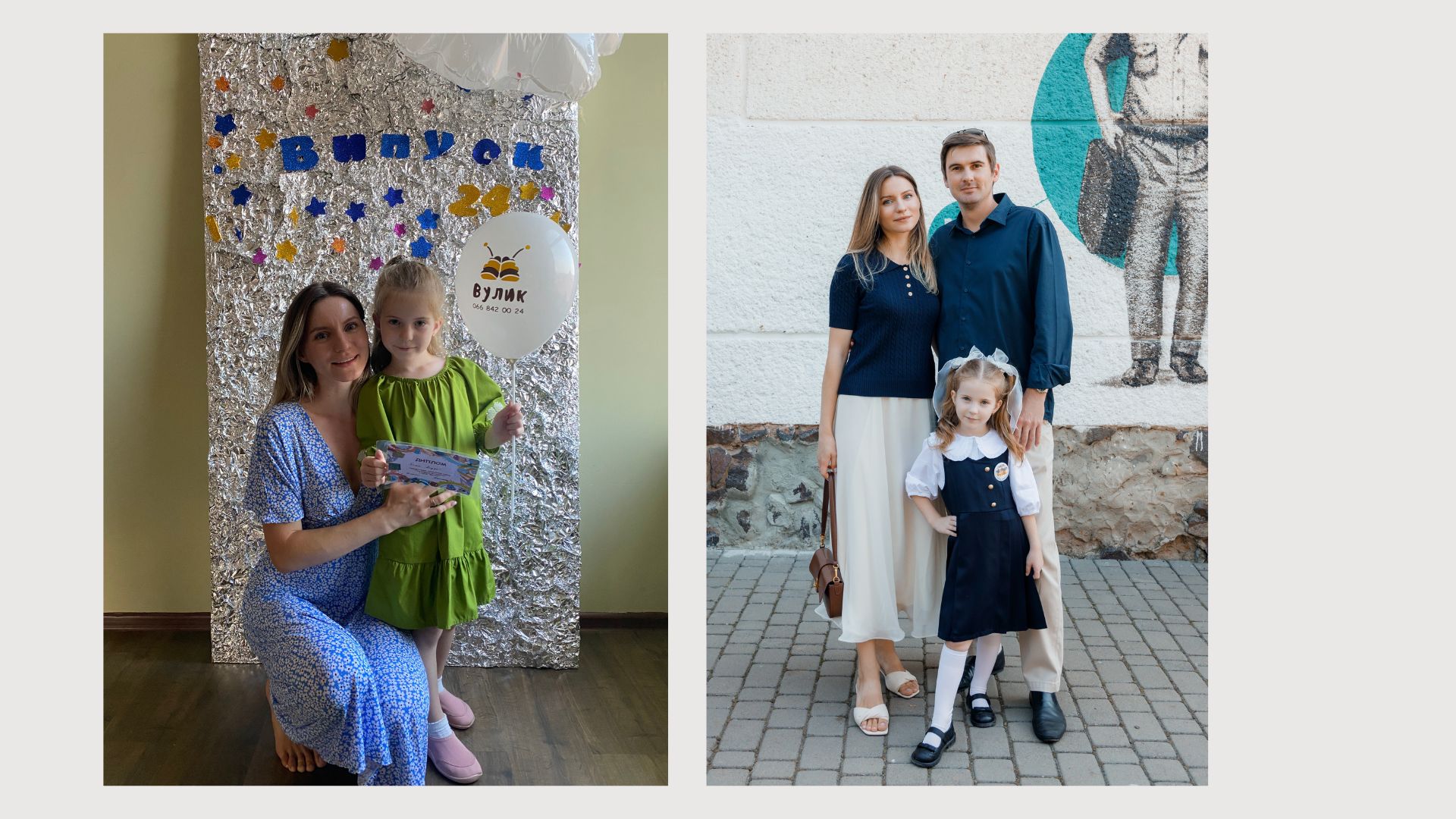
So, we made a practical decision: to find a good, empathetic teacher in a regular public school. At the same time, we clearly understood that preserving our child's individuality and nurturing her thirst for knowledge would require our active involvement at home, outside the school walls.
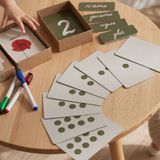
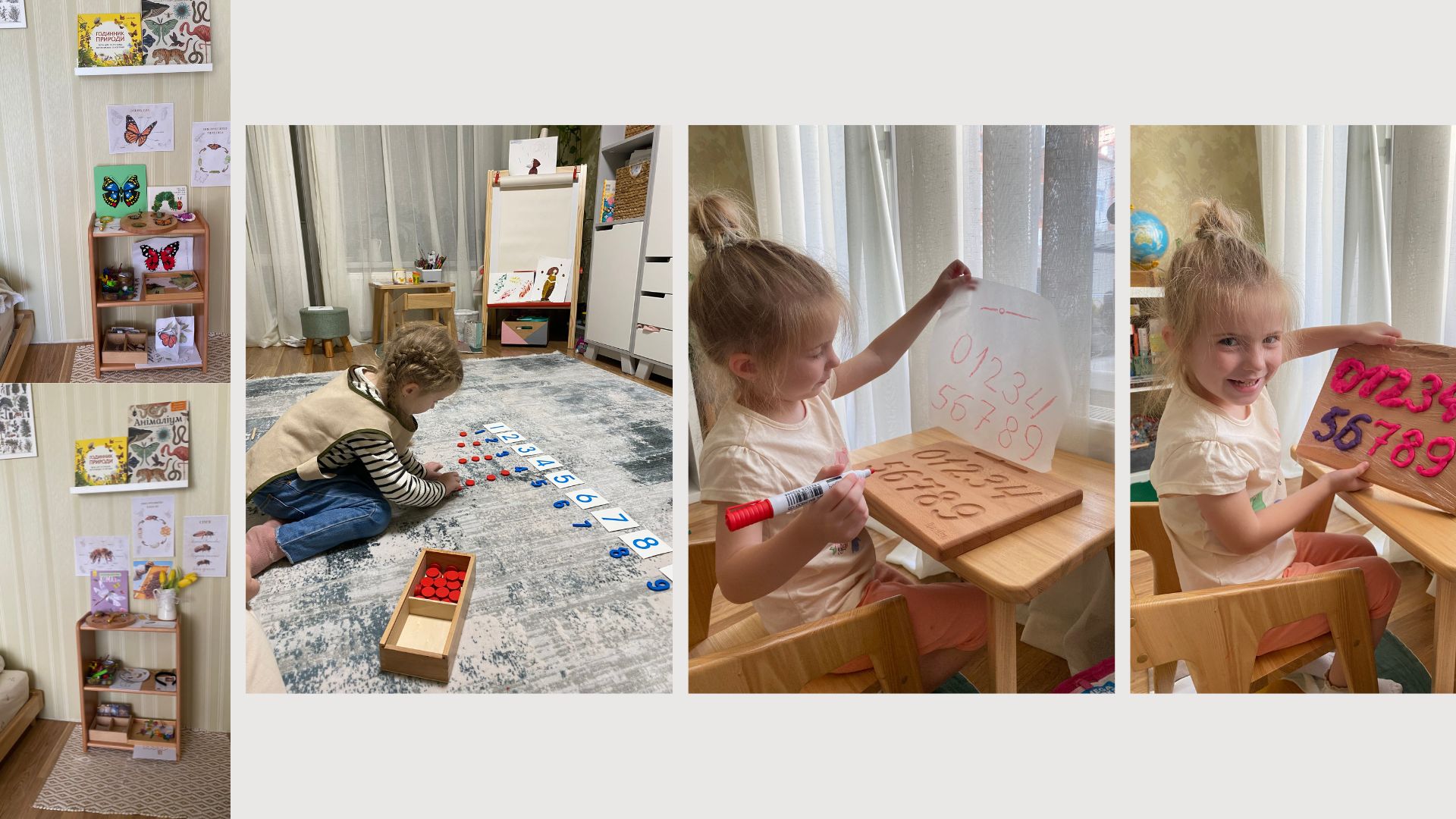
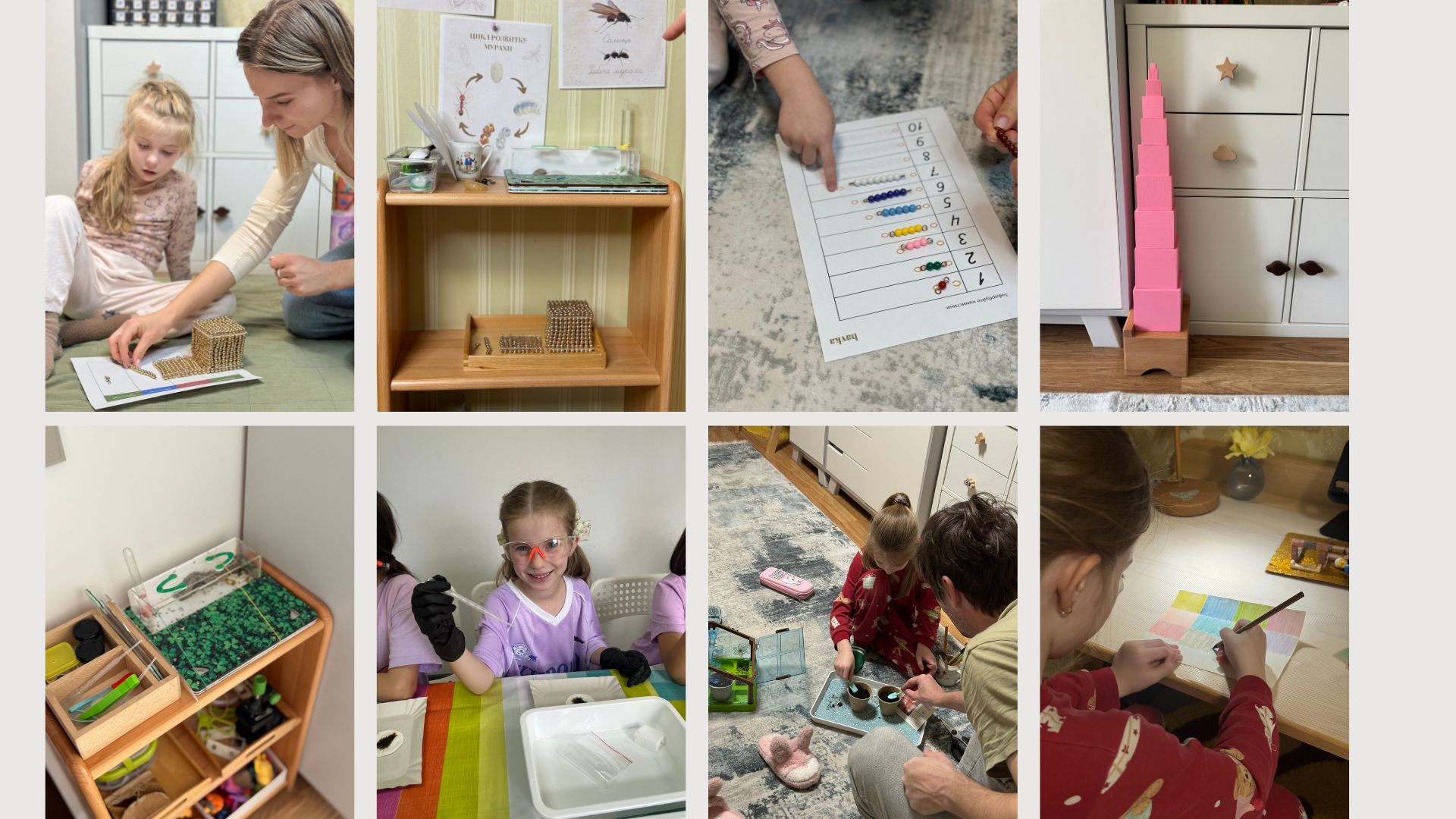
Leading up to first grade, I guided my daughter through Montessori-inspired preparation activities at home to build a foundational base, just as I envisioned it. Additionally, we took a school preparation course with a Montessori guide at a local private development center.
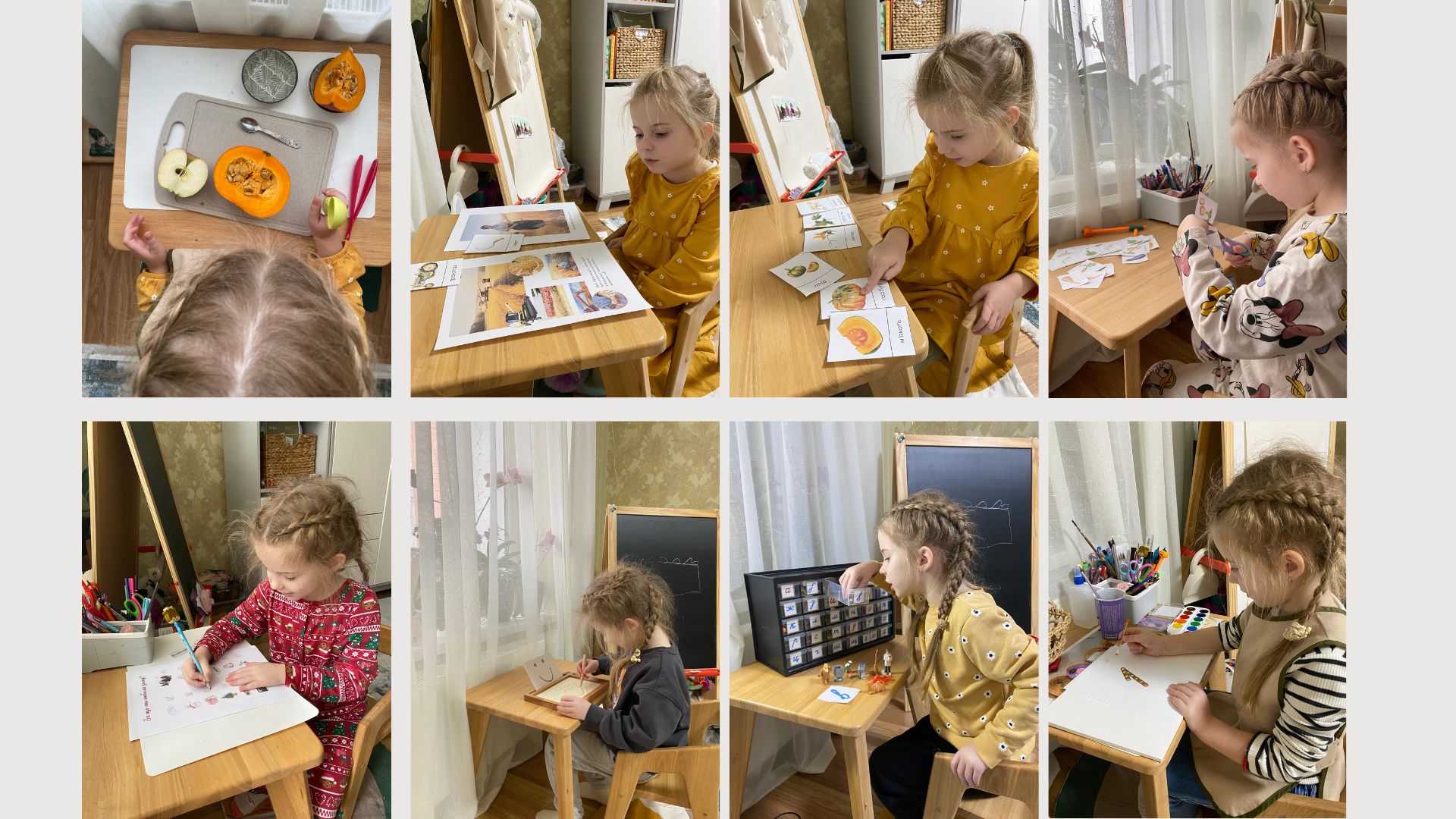
Am I satisfied with the current school system? Of course not. I believe it requires global reform, and many talented educators today are often held hostage by outdated curricula. However, it is a great blessing that there are teachers who adapt the material, present it engagingly, and step away from the standardized teaching methods of the 90s that simply do not work for modern children.
Traditional School vs. Montessori: What is the Difference?
To understand exactly how to support your child at home, it is essential to grasp the core differences between these two approaches.
| Characteristic | Traditional Public School | Montessori School |
|---|---|---|
| Freedom and Movement | The child sits at a desk. Movement is restricted by rules and breaks. | The child moves freely around the classroom. Movement is an instrument of learning. |
| Pace of Learning | Dictated by the curriculum and the teacher. Everyone does the same thing at the same time. | Individualized. The child chooses activities and works at their own pace. |
| Role of the Adult | The teacher is the source of knowledge and a controller. | The educator is a guide who observes and connects the child with the environment. |
| Motivation | Extrinsic (grades, praise, rewards, fear of punishment). | Intrinsic (joy from the learning process and the successful completion of a task). |
| Peer Group | Same-age children (competition). | Mixed-age group (collaboration, mutual help, absence of comparisons). |
How Traditional Schooling Kills Creativity: The NASA Experiment
In 1968, NASA initiated a large-scale study to find a way to identify highly talented engineers and scientists with unconventional, divergent thinking. Researchers George Land and Beth Jarman developed a special creativity test that worked perfectly on adult professionals.
But the scientists decided to go further and gave this exact same test to 1,600 children aged 4 to 5. They published the results of their study in the book Breakpoint and Beyond, and these numbers shocked the world: 98% of these children demonstrated the level of a creative genius!
The researchers decided to re-test these same children 5 years later. By age 10 (after a few years in a traditional school system), the genius level of creativity remained in only 30% of the children. When tested at age 15, the number dropped to 12%. NASA stopped its research there, but George Land went further and tested over 280,000 adults. Only 2% had retained their natural creativity.
Land’s conclusion was unequivocal: the cause is the school system and its restriction of free thought. The entire traditional system is built to make children think in standardized ways and suppress their individuality out of fear of making a mistake.
A Historical Lesson on Freedom and the Child's Will
In a Montessori school, everything works differently because the system is built around respect for the individual and their inner freedom. Recently, I listened to a lecture by Tetiana Kukla (a Ukrainian educator, 6–12 Montessori guide, and founder of the Montessori Family school in Cherkasy), and her words moved me to tears. She shared an example she called the "Historical Lesson of Freedom": when the Nazis invaded France, all French people felt their freedom restricted. Some could not live like that and emigrated, some put up active resistance, others passive resistance, while some adapted and submitted.
Then she said something incredibly profound:
"Now imagine a school where a teacher restricts the children's will, their needs, and their desires, simply because 'that's the system'... And how do children react to this restriction of freedom? Some refuse to go to school, some actively resist by arguing with the teacher, and some are passive, simply ignoring it. But some adapt—and attention, this is the worst outcome! Because by doing so, these children lose a piece of their own will."
Freedom and Limits: The River and its Banks
Freedom is the opportunity to act, but it is also the ability to act. As Tetiana Kukla emphasizes: "Just because a child is reading and has a book doesn't mean they know how to use it: to find necessary information, to understand what they read. Therefore, freedom in the classroom and its limits is a very complex concept... If a river had no banks, it would spread out and spill over. If it has no banks, it is unable to flow. Similarly, a child who has no boundaries has no physis (strength) to move freely. Boundaries must be reasonable and justified."
The magic of the educator (and of us, parents) lies in understanding which child needs how much freedom, and at what exact moment. This fully aligns with AMI logic: freedom and discipline are inseparable aspects of the exact same essence, like two sides of the same coin.
Extrinsic Motivation: Dogma or a Tool for Adaptability?
We have all heard the classic Montessori rule: we do not stimulate a child externally, because true discipline and interest must be born from within, from the feeling of "I can do this myself!".
For neurotypical children, this is the absolute truth.
But during that same lecture, Tetiana Kukla shared an interesting observation from her international colleagues regarding children with special educational needs. Such children often physically lack intrinsic motivation. They need an external stimulus (even a simple sticker) just to start taking action. And in such cases, extrinsic stimuli actually work.
This proves the most important point once again: there must be adaptability. Nothing is absolute. A school system where a teacher has 36 children in a classroom and needs to teach them to read and write in 45 minutes physically cannot provide this individualized approach.
Therefore, only we, as parents, can see the strengths and weaknesses of our child, evaluate them objectively, and support them where it is difficult for them. Our task is not to try to squeeze the child into the framework of a perfect curriculum, but to support them to the fullest.
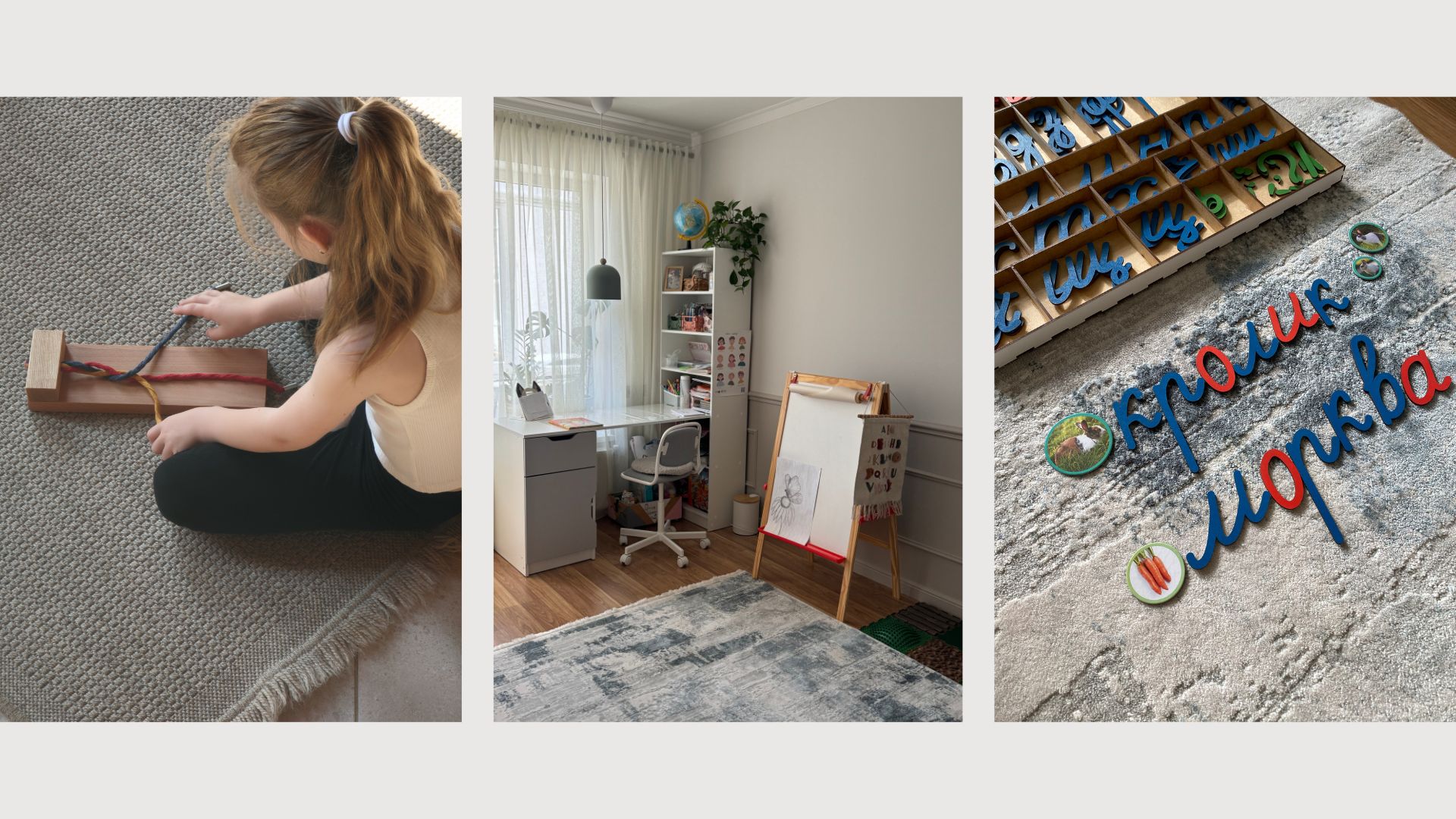
How to Organize the Routine and the First Workspace at Home?
Knowing the flaws of the traditional system, we compensate for them at home by working on our schoolgirl's self-esteem and organizing her space:
-
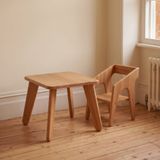
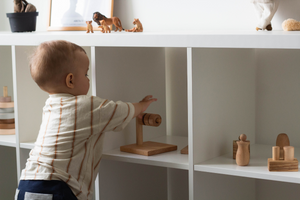
External order = internal order. A first-grader's workspace must be intuitive. Open shelves where everything has its designated place help the child structure their thoughts.
-
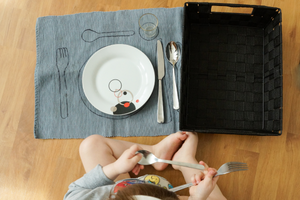
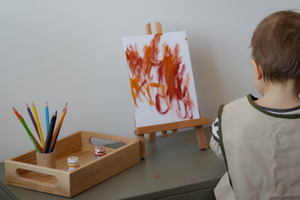
Accessibility and real tools. Stationery, paper, and books should all be at the child's eye and hand level so they don't have to constantly ask an adult to hand them something.
-
Filtering the unnecessary. At home, I try to show my daughter alternative ways of acquiring knowledge. If a homework assignment is blatantly pointless, we learn to highlight the main points and not waste resources on secondary things.
-
Free time. After school and homework, there absolutely must be time for free play and doing nothing. This is the time for restoring the child's will.
It is my dream that the system will eventually change. But for now, we do what is within our power: we love, we observe, and we create safe banks for our children at home.
How do you balance the demands of school with preserving your child's individuality?