Author: Alina Khoma
CEO of bavka, Montessori educator
Probably every mother knows this feeling on the eve of a holiday or simply while browsing children's product websites: information overload, thousands of bright plastic toys, flashing lights, loud sounds... Meanwhile, the boxes proudly display markings like "0+" or "3 months+", which often have absolutely nothing to do with a child's actual readiness and developmental needs. Manufacturers frequently buy age-category certificates purely for marketing purposes, creating an illusion of usefulness.
How do you avoid getting lost in this chaos and instead invest in what will truly support your baby, unlock their potential, and bring peace to your home?
I rely on the Montessori approach and a modern evidence-based foundation to help you figure out which gifts and materials will be the best investment in your child's first year of life. Our goal is to cut through the information overload, reduce anxiety, and give you a clear sense of direction.
The Main Principle: The Child is an Active Creator, Not a Passive Consumer
Maria Montessori proved that from birth, a child possesses an "absorbent mind." They naturally absorb the entire world around them through their senses and movement. Modern brain research fully confirms this: every second, thousands of new neural connections are formed in an infant, and this process is most intensively triggered through the work of their hands.
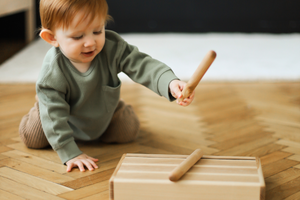
Therefore, the golden rule of choice is: we do not invest in toys that entertain the child while they lie passively; we invest in materials that encourage their own activity and exploration.
Top Investments by Developmental Stages: From Birth to 12 Months
Stage 1: From Birth to 3 Months — Adaptation and Visual Focus
During this period, the baby cannot yet control their body, but their eyes are doing colossal work.
-
The Find: A black-and-white high-contrast mobile. A newborn baby cannot differentiate colors yet, but they clearly see contrasts. Simple geometric shapes help them learn to focus their vision.
.png)
.jpg)
-
Action Step for Home: Set up a floor activity area with a mat and a safe wall-mounted mirror. Lying on their tummy, the baby will see their own movements, which stimulates the development of coordination.
Stage 2: From 3 to 6 Months — The First Intentional Grasping
A baby's nervous system matures from the top down and from the center to the periphery. The infant begins to intentionally reach for objects.
-
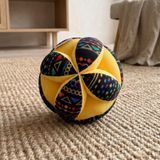
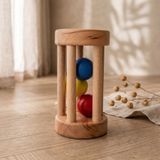
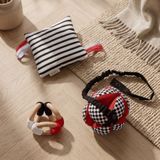
The Find: Interlocking discs and the Skwish (grasper) toy. The discs encourage the baby to transfer an object from hand to hand, developing the coordination of the brain hemispheres. The grasper encourages the baby to control their hands and fingers: to reach out, grab an object, and examine it. A natural fabric ball or its sensory variations are also excellent investments.
.png)
.png)
.png)
Stage 3: From 6 to 9 Months — Understanding Space and Object Permanence
The baby sits up, begins to crawl, and actively manipulates objects.
-
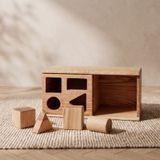
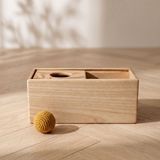
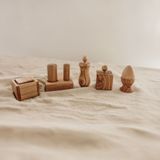
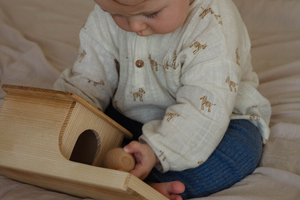
The Find: The Object Permanence Box. The child drops a ball into a hole, it disappears for a moment, and then rolls back out. This satisfies a crucial psychological need of this age—understanding that objects (and mom, when she leaves the room) do not vanish forever just because they are out of sight. 3D puzzle insets (a sphere, cube, and egg for fitting into matching cups) will also come in handy.
.png)
.png)
.png)
.png)
.png)
Stage 4: From 9 to 12 Months — Precision, Logic, and the Pincer Grasp
The child stands up on their feet, and their fingers become highly dexterous.
-
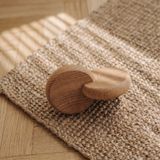
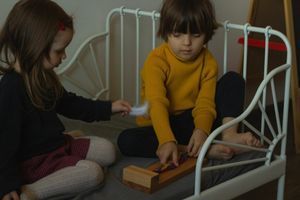
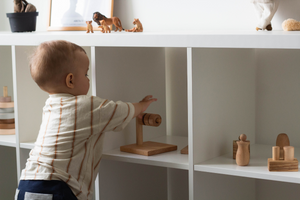
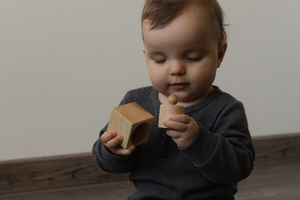
The Find: Shape sorters for various geometric figures (cylinder, cube, prism) and single-shape wooden puzzles with large knobs. A large round knob forces the child’s fingers to work in a pincer grasp, which is an indirect preparation of the hand for writing.
-
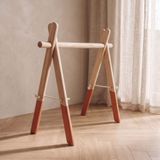
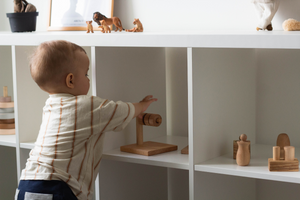
Action Step for Home: Fix a low wooden pull-up bar to the wall. Leaning on it, the child will be able to pull themselves up independently, developing gross motor skills without unnecessary adult help.
.png)
.png)
Other Finds as a Beneficial Alternative to Overstimulating Toys
.png)
.png)
.png)
.png)
.png)
.png)
.png)
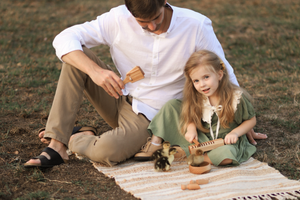
All age milestones are not a rigid schedule for competition, but merely an approximate developmental map. Observe your child's interest: if they are currently fascinated by tiny details on the carpet, offer them safe materials for finger precision; if they are trying to crawl, leave as much free floor space as possible.